Planning

Feb 05 13:29

No Cause for Shame

The Barrister at Maggie‘s Farm links to a collection of photos of the previous Penn Station in Manhattan. He begins by quoting a NY Times editorial:

"Any city gets what it admires, will pay for, and, ultimately, deserves. Even when we had Penn Station, we couldn't afford to keep it clean. We want and deserve tin-can architecture in a tinhorn culture. And we will probably be judged not by the monuments we build but by those we have destroyed."

—"Farewell to Penn Station," New York Times editorial, October 30, 1963

The building was a remarkable monument. And Minneapolis went through it own period of catastrophic renewal, where the most notorious lost monument was the Metropolitan Building.

Feb 02 21:03

The Minneapple Giants

Our Mayor is in a contest with State electeds to see who can offer the Vikings the sweetest deal. Rybak keeps offering up new sites and new funding mechanisms, but one thing he just will not do is let the public weigh in:

And then there’s the nearly $1 billion football stadium somewhere downtown that would continue to bolster the economy.

“People pay me to look big problems in the eye and come up with a solution,” said Rybak. He said he is willing to make changes in the proposal and points out that he has already backed off the idea of funding the package with a casino on Block E and has remained flexible on the three proposed Minneapolis locations.

But he has said he is against the idea of a referendum, saying that citizens will get their chance to vote when he stands for re-election.

Everybody knows the next Mayor is going to be Gary Schiff, anyway. Schiff opposes taxpayer funding of stadia, but if R.T. signs a deal, it is too late for an election to save us.

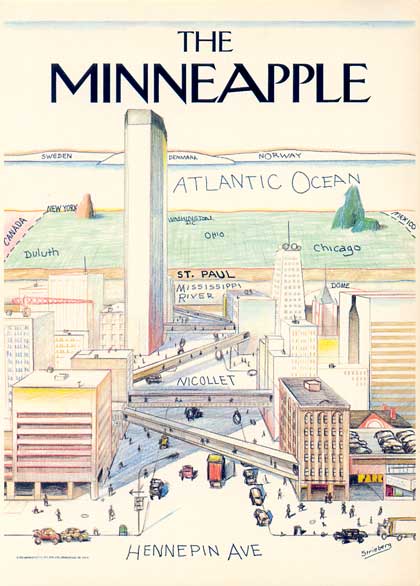
The saying goes that without all these luxurious downtown amenities, Minneapolis would be a cold Omaha. I’m not sure that’s a bad thing. Our civic bigshots view our town as something bigger than it is. Like this…

New Yorker magazine stylized map of Minneapolis at the center of the world

H/T: Nokohaha

Jan 13 19:22

Dickens’s New Beat

Detroit’s failed economy stimulates failed journalism:

if Detroit has any single sector that's booming, it's playing host as the epicenter for a nation of journalists-turned-poverty tourists. Morton talks with James Griffoen, who is said to be a frequently sought out urban "sherpa" for journalists looking for a quick dose of "ruin porn."

D-Town, the place nobody wants be, but everybody wants to hear about.

May 22 20:06

Moving Back to the Country

As someone who grew up in a city and ended up in a rural area, I can talk about what it’s like to make such a move. These days it is much easier to live in a rural area now that we have the Internet and email available to keep us connected. What initially seemed like a problem, the lack of good shopping, is less of a problem because even when I do get to the good stores I want to patronize, they don’t seem to have what I want. It’s much more convenient just to order on the Internet. The major problem of rural areas, then, is simply the lack of good restaurants, for which I have no solution other than an occasional trip to a big city.

Big-box shopping is often dismal. They stock everything, but only the thre most popular sizes or styles. I have friends who live a mile or few away from me in the big city, and I rarely see them, but stay in touch thanks to the intertracks.

I have some foodie pallys, and after a recent dinner, they agreed that the best measure of a city was its dining scene. Myself, I don’t go out much anymore.

Perhaps I should consider escaping the planners, the criminals and assorted leftoid nags that define urban living.

Apr 24 12:31

Poisoning Public Transport

I’ve seen several headlines about two Delta Airlines employees ambushed by a gang of teens while riding Atlanta’s commuter rail.

Borepatch, an expert in computer security, sees the incident in those terms:

Security types call this a "Resource Poisoning" attack, where something that was previously valued and trusted becomes worthless because of abuse.

Crime need not be actualized for resource poisoning to occur. If the environment feels unsafe, people choose not to take the trip.

The Hiawatha Line in the Twin Cities has certainly not been crime-free. But since transit authorities use ridership as their measure of success, there’s a disincentive against making problems widely known. Alerts may be posted at stations, but the general voting public only hears how wonderful the system is working.

Apr 15 21:36

Minneapolis Riverfront in the Days of Disco

The now-demolished Great Northern Depot in downtown Minneapolis could inspire many posts on railroads, how changes in transportation technology changed the role of railroads, and how that allowed planners to re-purpose land at the core of cities, specifically Minneapolis, since this depot stood at the gateway to Northeast Minneapolis. Those changes were driven by economics and politics.

But I’m not ready to launch into any of those. I just happened across an archive of photos of the Great Northern Depot from the 1970s. It was one of those times where I was following the intertracks without a destination in mind, and found a treasure. For railfans and history buffs, at least.

Mainstream preservationists and historians—if that’s not an oxymoron—seem mostly interested in façades. I’m more fascinated to understand how the buildings worked.

1978 view beside Post Office looking upriver toward GN Depot

Apr 13 10:04

Planning FAIL — Boston Edition

Boston, like nearly every U.S. city, ripped out large swaths of its core to accomodate motorists in the 1950s and 60s. Boston’s downtown freeway was called the Central Artery (a great name, that sounds even better in the native accent). In the 1970s, Boston, like most places began to realize that freeways tend to break up the organic pattern that makes urban living interesting and attractive.

So the planners came up with a plan to correct the plans of the planners who tore out the city’s guts to build interstates. They would bury the Central Artery. Put the traffic underground, and instead of a noxious concrete wasteland dividing neighborhoods, there would be an open green space at ground level to re-unite Bostonians.

Minneapolis dreamers have a similar vision. I’ve seen sketches of a park built over I-35W around 35th to 38th Streets. It would expand an existing park (MLK) and repair a gash in the Field, Regina Northrup neighborhood. Since we just reconstructed I-35W in south Minneapolis, that plan will be locked in the dream stage for at least a few more decades.

Which is good, because in Boston, all they did was change the color of the barrier from gray to green:

Apr 09 13:14

It’s Not Just Minneapolis

A decade or two of the New Urbanist vision has led to some shiny and popular developments. But on the whole, urbanist claims about walkable villages being what the market demands are not supported by the facts.

Take Gotham City:

Some of the best evidence that the tide has not turned against dispersion and suburbanization comes from an unlikely source:  New York’s 2010 census results. If dense urbanism works anywhere in America, it does within this greatest of US traditional urban areas.


In all, this 23 county metropolitan area has the nation’s largest population and actually extended its margin over second place Los Angeles, which has been converted from a growth leader to a laggard giant growing slower than most Midwestern metropolitan areas. New York added 574,000 residents, while Los Angeles added 473,000.


If you had read the New York Times and other Manhattan-based media over the last decade you would have assumed the suburbs were in decline and cities ascendant, particularly in the New York area.

Apr 09 12:51

Minneapolis Planning Fail

I used to be one of those urban snobs who would rant about the god-forsaken suburbs. I could go on and on about treeless cookie-cutter tracts of sterile garage doors hiding soulless monotony that passed for neighborhoods. Now I am wiser.

The suburbs have advantages, and the form of development is a minor factor in quality of life. I still prefer the city, but I am not so arrogant about it. But planners and the electeds who hire them are still filled with hubris.

For the decade-plus I have been involved in neighborhood activism, at the grassroots of urban planning efforts, I have seen millions poured into subsidizing development in Minneapolis. We’ve turned abandoned downtown railyards into residential neighborhoods, home to tens of thousands. We built a light rail line to connect the Minneapolis core to the other major regional amenities.

The new stuff did attract people. But on the whole, how have our planners served out city? Did they provide—via subsidy—the kind of lifestyle that a majority of area residents preferred?

Dec 08 2010

Stuck on Stupid

Residents of Minneapolis are looking at a property tax increase approaching 20% next year.

The proposed tax increase is the city’s response to growing pension obligations, cuts to Local Government Aid (LGA) and recertification of Tax Increment Financing (TIF) districts that fund neighborhoods and pay Target Center debt. The hike is based on a 7.5-percent, $20 million levy increase, which translates to an actual tax increase of roughly 10 percent to 20 percent for most Minneapolis property owners.

As much a the Mayor and the City Council want to blame the State Legislature for not providing enough aid (LGA), this problem is the product of years of poor fiscal management.

Oct 01 2010

Unplanned Obsolescence

Planned obsolescence is an concept most notoriously associated with American autos from the 1950s:

GM chief designer Harley Earl implemented his "planned obsolescence" scheme that changed car body styles every three to five years to induce the public to buy a new model.

Earl's marketing plan affected the design of rear tail fins on cars, which were modest in early 1950s Cadillacs, but grew larger and more flamboyant by the time 1959 Cadillacs debuted.

Sep 04 2010

Rover’s Dream Denied

Another instance of the failed promise of a post-racial America under President Barry “The Mutt” Obama:

After an emotional meeting Thursday night where neighbors split along racial lines over whether an off-leash dog site should be built at Martin Luther King Memorial Park in south Minneapolis, the Park Board president said other options should be sought.

…much of the debate centered on whether the dog park would dishonor King, the slain civil rights leader.

It’s just an amenity in a City park, not a political statement. And dogs set the standard for judging each other not by the color of their fur, but by the content of their…um, “character”.

Sep 03 2010

Local Bike Nut Meets the Real World

The administrator of the premier bicycling bulletin board in Minneapolis is calling it quits:

Aug 08 2010

Government Shrinks, Commerce Increases

From the Antiplanner:

Late last year, Clayton County, Georgia (a suburban Atlanta county) decided to terminate its subsidized bus service to Atlanta, saying it was costing $10 million a year but only bringing in $2.5 million in revenue. Despite protests from bus riders, the service was duly ended on March 31, leaving many riders worried that they would not be able to reach their jobs.

Starting this week, a private party has started a new bus service following some of the same routes as the Clayton County buses. Fares will be $3.50, compared with average fare collections on the County buses of about $1.10 in 2008.

Look for more of this as local governments head toward insolvency over the next several years.

Aug 07 2010

A Proposal Without Positives

In my time as neighborhood activist, I have supported and opposed many development ideas. The arguments—at least the public arguments—always revolved around the benefits, costs, and risks of a given proposal.

The near-WTC mosque supporters are not engaged in this sort of development and planning argument:

listen to the defenses being put up by the backers of the mosque. Boil it all down, and that is their argument in its entirety: "it's not illegal."

"We have the right to build our center here, or any place else."

"The Constitution guarantees our right to have our houses of worship."

"Those opposing us are bigots and prejudiced against Muslims."

Jul 22 2010

Up and Down are Relative

Australia is “down under”. But that’s only an artifact of where the ancient mapmakers lived. This view is equally valid in the geographic and astronomical senses:

Politcal map of the world with Australia at the top

H/T: Theo Spark

Jun 11 2010

The Cost of Community Organizing

The Minneapolis Mirror does a little investigating and calculating of a northside neighborhood group:

The cost of having 3 staff for the Hawthorne Community Council is $183,852 or $61,284 each.

$61,284 divided by 1715 (actual working hours total) = $35.73/hr

So what did the residents of Hawthorne receive for their $35.73/hr on June 2nd 2010?

May 24 2010

Imagineering for Central Avenue

The City of Minneapolis has an array of programs aimed at invigorating weak commercial districts. Central Avenue—mostly within the 55418—has been awarded its second subsidy under one of these initiatives, The Great Streets Program:

In 2007, the Minneapolis City Council approved the Great Streets Neighborhood Business District program, a coordinated effort to help businesses develop and succeed along commercial corridors and at commercial nodes throughout the city.

City resources are available for business loans, real estate development gap financing, and business district assistance such as façade improvement programs, market studies, and retail recruitment efforts.

Apr 09 2010

It May Come, But They Do Not Ride

I observed the Northstar commuter rail service make its 4:40pm outbound stop at the Fridley station. I did not see anyone get off the train. There ten vehicles in the park-and-ride lot.

The locomotive was in the livery of FrontRunner, a commuter rail service in Utah. Perhaps there were no riders there, thus freeing a power unit to pull our empty trains.

Mar 23 2010

The Enemy Within

The greatest threat to any living organism or nation is not to recognize danger in time.

Quoted from: Benjamin Netanyahu

via Dr. Sanity