Technology

Why Pay More? $7.49 .COM Domains from GoDaddy.com 468x60

Jan 08 19:37

Turn This Ship Around

CVN-76 nuclear carrier listing to port under hard rudder at full speed

The USS Ronald Reagan (CVN-76) under full rudder at speed. She is 1,092 feet long, her deck is 252 feet wide, and she weighs 101,400 tons.

If you zoom waaay in, you can see Ron Paul at the helm.

Sep 24 11:47

Nuts on Nets

The Internet’s full of small, vindictive, unbalanced, and ugly people who don’t have the slightest qualms about using any and every tactic imaginable to go after people who irritate them.

Quoted from: John Hawkins

Aug 04 16:11

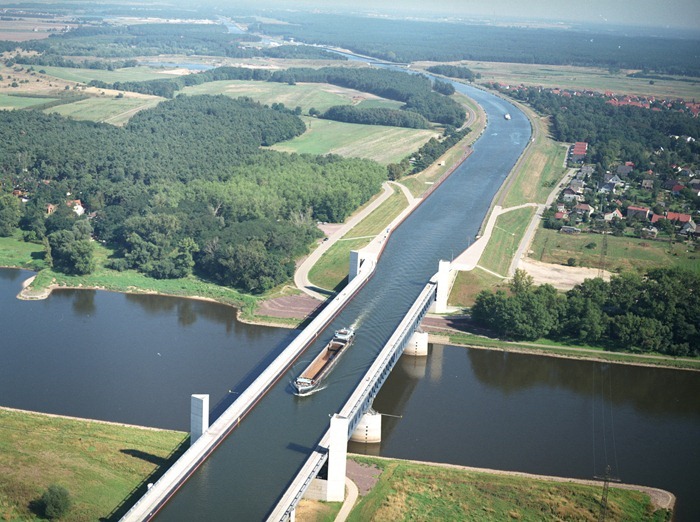
Magdeburg Water Bridge

Barge canal carried by aqueduct over Elbe River

Yes, that is a shipping canal crossing over a river.

Infrastructure is cool.

H/T: Theo Spark

Jun 20 14:38

Greens Must Hate Birds

Cartoon making fun of wind power

Apr 29 20:10

Capitalists Cross Final Frontier

The Enterprise, from Star Trek, was a government vessel. In the 1960s it would have been fantasy to think a privately-owned company could boldly go where no man had gone before.

Fifty years later, it isn’t a fantasy. I’m acquainted with Virgin Galactic. But that’s more an vertically-oriented amusement park ride than a serious industry. Enter SpaceX:

SpaceX was founded in June 2002 by PayPal co-founder Elon Musk who had invested US$100 million of his own money by March 2006. On August 4, 2008, SpaceX accepted a further US$20 million investment from the Founders Fund.

SpaceX has nearly doubled in size every year since it was founded in 2002. It grew from 160 employees in November 2005 to more than 500 by July 2008, to over 1100 in 2010.

Musk believes the high prices of other space-launch services are driven in part by unnecessary bureaucracy. He has stated that one of his goals is to improve the cost and reliability of access to space, ultimately by a factor of ten.

Apr 24 12:31

Poisoning Public Transport

I’ve seen several headlines about two Delta Airlines employees ambushed by a gang of teens while riding Atlanta’s commuter rail.

Borepatch, an expert in computer security, sees the incident in those terms:

Security types call this a "Resource Poisoning" attack, where something that was previously valued and trusted becomes worthless because of abuse.

Crime need not be actualized for resource poisoning to occur. If the environment feels unsafe, people choose not to take the trip.

The Hiawatha Line in the Twin Cities has certainly not been crime-free. But since transit authorities use ridership as their measure of success, there’s a disincentive against making problems widely known. Alerts may be posted at stations, but the general voting public only hears how wonderful the system is working.

Apr 15 21:36

Minneapolis Riverfront in the Days of Disco

The now-demolished Great Northern Depot in downtown Minneapolis could inspire many posts on railroads, how changes in transportation technology changed the role of railroads, and how that allowed planners to re-purpose land at the core of cities, specifically Minneapolis, since this depot stood at the gateway to Northeast Minneapolis. Those changes were driven by economics and politics.

But I’m not ready to launch into any of those. I just happened across an archive of photos of the Great Northern Depot from the 1970s. It was one of those times where I was following the intertracks without a destination in mind, and found a treasure. For railfans and history buffs, at least.

Mainstream preservationists and historians—if that’s not an oxymoron—seem mostly interested in façades. I’m more fascinated to understand how the buildings worked.

1978 view beside Post Office looking upriver toward GN Depot

Mar 24 20:28

Nazi Technology

German engineering is not always brilliant. I can imagine this “Rail Zeppelin” was a work of machining art. But a giant propeller whirring right beside passenger platforms did present a safety challenge.

Propeller-driven railcar beside passenger platform

The Wired Magazine article on this one-off wonder makes an interesting point:

The concept and execution of Schienenzeppelin (“Rail Zeppelin”) predated the Nazis by years. Like quantum physics, Bauhaus architecture and Marlene Dietrich, it was a product of the Weimar Republic. All the Nazis contributed was the loco’s eventual dismantling to turn its aluminum into Messerschmitts.

Nazis get more credit than they deserve for technological advancements. They were the first to field jet fighters and guided missiles. They produced motor fuels (gasoline and diesel) from coal. The Allied powers were concerned about their potential development of nuclear weapons. But all those were applications of ideas already exisiting when the Nazis gained control.

Mar 20 12:13

Nuclear Disaster in Marhsall Terrace

A couple of years ago, the Riverside Power Plant in the 55418 was converted from coal fuel to natural gas. It had burned coal and coated the Marshall Terrace neighborhood with ash and dust for the previous eight decades.

It never made headlines as a radiation hazard. But it was:

In a 1978 paper for Science, J. P. McBride at Oak Ridge National Laboratory (ORNL) and his colleagues looked at the uranium and thorium content of fly ash from coal-fired power plants in Tennessee and Alabama. To answer the question of just how harmful leaching could be, the scientists estimated radiation exposure around the coal plants and compared it with exposure levels around boiling-water reactor and pressurized-water nuclear power plants.

Mar 15 12:00

Godzilla in Pinstripes

The headlines appear obsessed with panic about radiaton. That danger has largely passed. Although, there is no such thing as “safe”. There is always risk. And Big Media plays into ignorance and panic.

First, the good news.  The second plant, containing four reactors about a dozen or so kilometers from the one that has been the subject of all the reporting, has reached cold shutdown on all four reactors.  The destroyed pump motors (from the tsunami) were replaced and the plant is stable.  That part of the story, barring some sort of new issue, is over.  Note that a couple of days ago this plant was on the verge of a full-scale disaster.

Reactors #1 and #3 have suffered core damage.  The containment, however, is intact at both.  Both buildings (outer building, intended to keep the environment out, not nuclear things in) have been damaged  The reactors in both cases are shut down and the problem is residual decay heat, which has to be managed.

Mar 13 11:57

Seeing In Darkness

Traffic has been light here on NRR. As part of my personal experiments for the New Year, I decided to abstain from Big Media news. I still see most of the headlines, but I do not know the stories being told.

(Also, I have been blessed with a rush of real, billable work in the meat world, leaving little time for pithy observations and therapeutic snark.)

There have been big events which I would have been following closely. The political poker game in Wisconsin appears to confirm my view of an upcoming period of violent upheaval as those accustomed to political favors throw tantrums when confronted by economic reality.

The upheavals across the Arab world are exciting. The current President is showing incompetence in a new arena. Or, more generously, real politics are so much more complex than campaign politics.

And there is Japan. A place I have never been, but where I think a bit of my soul resides. The disaster-and-death aspect is tragic. But tragedy also makes heroes.

I understand there are parts of New Zealand that may not be rebuilt, too, from an earthquake a couple of weeks ago. Did anyone care about that?

Mar 12 01:05

Reactionary Radio

Perhaps it is an example of Yin and Yang chasing each other around the wheel of life. Those who successfully speak truth to power become power. What was once novel and avant-garde is accepted as status quo.

Cobb spews a bit about NPR’s evolution toward irrelevance:

By the time NPR fired Juan Williams, I was too through with them and really expected nothing more. But you can't stay mad forever. So I have found myself turning back, begrudgingly. It's rather a different beast. Now there are commercials all the time, and there are a bunch of names I don't recognize reporting, only showing how strange it is to realize that NPR is essentially about 30 people. And even what they do is getting, well. How can I say it? NPR just can't compete with some really good podcasts - they just don't geek out enough. NPR is about flavor and style. It's not cutting edge anything. It's just like HBO. I don't mean to say that it has the amoral in-your-face-ness that was HBO when I stopped watching several years ago, but that it has become something of a parody of itself having become predictable and no longer being the best at what they do.

Somewhere—probably via Robert Anton Wilson—I recall a theory that information is that which you cannot predict.

Mar 11 18:05

Robots Displacing Clerks

In economic theory, labor combines with capital to produce goods. In normal language, that means people work with machines to make stuff.

Labor and capital (people and machines) can be subsituted for each other. If the backhoe breaks, we can dig holes by hand. Or, if hiring workers becomes too costly, someone will develop machinery to do the job:

Automation — long a force in agriculture and manufacturing — is accelerating in the retail sector, a trend that could hamper efforts to bring down the nation's stubbornly high jobless rate.

In an industry that employs nearly 1 in 10 Americans and has long been a reliable job generator, companies increasingly are looking to peddle more products with fewer employees. Shipping and warehousing workers are being replaced by robots that can process packages more efficiently than humans. Virtual assistants are taking the place of customer service representatives. Kiosks and self-service machines are reducing the need for checkout clerks.

Mar 06 10:30

Newsprint Kills Newspapers

From a lengthy—but worthwhile—London Review of Books story about the newspaper business:

in the US, the newspaper business is a local one, with a strong tendency towards de facto monopoly. Most of America’s cities have (or had) a dominant newspaper, and that paper had a monopoly of classified advertising. During the long years of the 20th century’s newspaper boom, that monopoly was the proverbial licence to print money.

Economic theory holds that there are very, very few sustainable monopolies. Without government protection from competition through licensing and regulation, human nature will produce either competition for the monopolist’s profits, or technology which makes the monopolist‘s business model obsolete.

The internet is the package of technologies which killed print newspapers. Not the desire for news, but abilty to print money by publishing news:

Feb 05 2011

IT Knows

The privacy you're concerned about is largely an illusion.

Quoted from: Larry Ellison, co-founder of Oracle Corporation.

===

And a two-line corollary from Scott McNealy, co-founder of Sun Microsystems:

You have zero privacy anyway. Get over it.

Dec 22 2010

Word Lens

Not quite the Babel fish, but this is only version 1.0:

Future versions that work with Kanji and Arabic could change the world.

H/T: Maggie’s Farm

Dec 13 2010

The World is Awash in Oil

Not in the greasy-pelican pollution sense, but in the magic of higher prices leading to increased production:

As an article last month in The New York Times observed: “Just as it seemed that the world was running on fumes, giant oil fields were discovered off the coasts of Brazil and Africa, and Canadian oil sands projects expanded so fast, they now provide North America with more oil than Saudi Arabia. In addition, the United States has increased domestic oil production for the first time in a generation.” Further still: “Another wave of natural gas drilling has taken off in shale rock fields across the United States, and more shale gas drilling is just beginning in Europe and Asia.”

A few years back, when oil was $120+ per barrel and gasoline was over $4 per gallon, the economically ignorant were concerned about the end of oil. Then the depression started and oil dropped back to the 60s for a while. The price of crude has drifted upward into the 80s over the past year. But the break-even price to make all those new fields viable was in the 40s.

So North American drillers kept working their plays.

With rising production from shale fields, the U.S. surpassed Russia last year to become the world’s largest supplier of natural gas.

Dec 06 2010

Grassroots Warfare

Recent travels along the intertracks have led me outside my usual routes and on to several military-focused bloggers. I used to be a big-time wargamer (never a real soldier, though), but that interest has been dormant for quite a while. Nevertheless, I still find it fascinating.

Military procurement is as much a political issue as an economic or technological one. That hasn’t changed since I stopped paying attention. Expensive and flashy weapon systems always get priority when Congress decides on military funding. The ordinary infantryman has no lobbyist in Washington.

From my studies of war, I remember that infantry is called “the Queen of Battle”. Everything else in war is ultimately deployed to support the infantry. The goal of war is to enable your troops to occupy unmolested a given patch of ground. It’s about control of territory. And that’s what the infantry does.

Dec 06 2010

Do or Dazzle

If it’s stupid but it works, it isn’t stupid.

Quoted from: Bring the Heat

Dec 04 2010

Chinese Set Rail Speed Record

A Chinese passenger train smashed World speed records after hurtling at speeds of over 300 miles per hour.

The speed record was set during a test run of the yet-to-be opened link between Beijing and Shanghai according to the Xinhua News Agency.

Reaching 302 miles an hour (486 kilometers per hour) the train clocked up the fastest recorded speed by an unmodified conventional commercial train.


The new line is due to open in 2012 and will halve the current travel time between the capital Beijing and Shanghai to five hours.